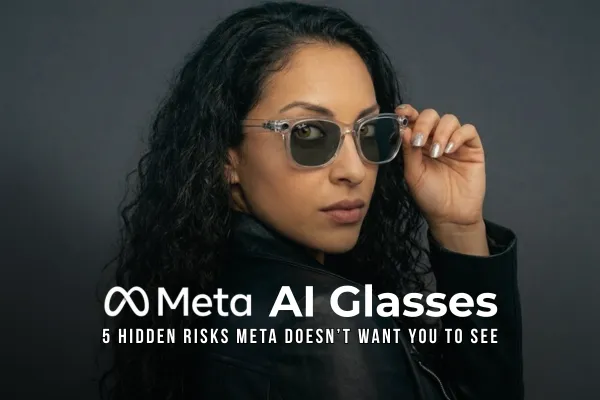
5 Hidden Privacy Risks of Meta AI Smart Glasses (And How to Protect Yourself)
Creative Minds
Contents:
The Rise of the Always-On Society
Risk #1: Real-Time Facial Recognition & The 3-Billion-Person Database
Risk #2: Human-in-the-Loop: Are Kenyan Contractors Watching Your Life?
Risk #4: Legal Gray Areas & The Death of Public Anonymity
Risk #5: The "Default-On" Problem & Surveillance Maps
Simple Ways to Keep Our Privacy in Our Own Hands
1. Can Meta AI glasses record without the LED light turning on?
2. How do I turn off the human review of my footage?
3. Is it legal for someone to identify me using their glasses?
4. Does the AI process my data even if I don't take a photo?
Have you seen those new Meta glasses? I mean, really seen what they’re doing?
Imagine walking into a coffee shop and—just by looking at you—a total stranger knows your name, your home address, and where your parents live. It sounds like a scene from a stalker thriller, but two Harvard students just proved it’s our current reality.
With over 7 million pairs of these AI-powered specs sold in 2025 alone, we aren't just wearing tech anymore; we’re wearing a massive data pipeline on our faces. I’ve been digging through the 'fine print' that Meta doesn't want to put on the billboard, and what’s happening behind those lenses is a lot messier than you think.
The Rise of the Always-On Society
I know, I know… These glasses look incredibly sleek. It’s funny, for years, we all wanted to get rid of our frames, and now that I finally have 20/20 vision thanks to Lasik, I’m looking at these Meta frames thinking, "Wait, are glasses cool again?" 🤓 They definitely are, but they come with a catch.
In 2025, sales for AI smart glasses exploded, hitting over 7 million units. We’ve officially entered the era of the "Name Tag" leak, where a stranger wearing a pair of Ray-Ban Metas can potentially pull up your Instagram profile or LinkedIn just by looking at you. It’s like living in a sci-fi movie, but without the cool soundtrack.
Risk #1: Real-Time Facial Recognition & The 3-Billion-Person Database
The biggest elephant in the room is Meta’s massive database. With over 3 billion active users, the potential for real-time facial recognition is staggering. Even if you aren't on Facebook, you might be in a "shadow profile."
Shadow Profile: A collection of data that a social media company (like Meta) keeps on you, even if you have never signed up for their service. This information is gathered from your friends' contact lists, photos you've been tagged in by others, and now, data captured by smart glasses. Essentially, the AI "knows" who you are based on the digital footprint others leave behind.
The Electronic Privacy Information Center (EPIC) recently warned that this feature "must not be allowed to reach the market" because it risks turning public spaces into zones of constant stalking and doxxing. Imagine walking into a grocery store and having every person’s name, job, and marital status pop up over their heads. It’s an analogy for a world where anonymity is a relic of the past.
Risk #2: Human-in-the-Loop: Are Kenyan Contractors Watching Your Life?
This is where things get a little creepy. We often like to imagine AI as just a bunch of cold, unfeeling code. However, "Human-in-the-Loop" (HITL) means that actual people are frequently reviewing the footage your glasses capture to "train" the system.
A 2026 investigation revealed that contractors in Kenya were reviewing sensitive clips. Some of these even featured people in bathrooms or intimate settings because the wearer didn't realize the glasses were still recording. While Meta claims they blur faces, reports suggest the tech isn't always perfect. Honestly, it’s like having a silent, invisible roommate who sees every single thing you do.
Risk #3: Cloud Auto-Sync
By default, many of these glasses are set to auto-sync with the cloud. This means the second you snap a photo or the AI "analyzes" a scene to help you translate a menu, that data is zipping off to a server.
Unless you go into the weeds of the settings, your private moments are being transmitted through an invisible pipeline. As the Electronic Frontier Foundation (EFF) puts it, "Your biometric data is some of the most sensitive pieces of data a company can collect." If it's in the cloud, it's vulnerable to breaches, subpoenas, or just being used to train the next version of the AI without your explicit consent.
Risk #4: Legal Gray Areas & The Death of Public Anonymity
Legally speaking, we are in the Wild West. Current laws in many places allow people to be photographed in public without consent because there is no "reasonable expectation of privacy."
However, smart glasses take this to an extreme. Continuous filming isn't the same as snapping a quick photo. There is no First Amendment protection that covers the right to use AI to identify every person on a city street. We are essentially watching the death of public anonymity in real-time, and our legal systems are still using dial-up logic in a fiber-optic world.
Risk #5: The "Default-On" Problem & Surveillance Maps
Have you seen those "Search Party" style maps where you can see exactly where people are in your neighborhood? Smart glasses could turn that into a surveillance nightmare.
The "Default-On" nature of these devices means they are constantly sensing their environment. If thousands of people in a city are all wearing these, Meta could theoretically create a real-time, 3D map of every street, including who is where and what they are doing. It's like living in a 24/7 reality show where the cameras are invisible. Instead of having walls that keep people out, we’re surrounded by smart lenses and computer chips that let the whole world in.
Simple Ways to Keep Our Privacy in Our Own Hands
Even though these glasses are a blast to use, privacy experts from groups like the EFF (Electronic Frontier Foundation) and EPIC (Electronic Privacy Information Center) say we should look for a few specific features to keep our personal lives personal. Instead of just "hoping" a company keeps our data safe, we can look for these more user-friendly options:
Keeping things local: It is always better when your photos and videos stay on the glasses or your phone instead of being sent to a giant server in the clouds. The EFF specifically warns that "cloud media" settings can transmit your private moments before you even realize it.
Clear "Delete" buttons: We should have an easy way to see exactly what is being saved. We also need to know for sure that when we hit "delete," the data is actually gone for good. EPIC has recently pushed for regulators to ensure that these "deletion timelines" are strictly followed and audited.
Easy "Off" modes: Just like putting your phone on "Do Not Disturb," it would be great to have a simple, foolproof way to make sure the cameras and mics are totally off. Experts are concerned that a tiny LED light isn't enough to tell a bystander they are being recorded, so a physical way to "kill" the power to the camera would be a huge win for everyone's peace of mind.
I love tech as much as anyone, and the idea of having an AI assistant in my ear while I navigate a new city is incredible. But we can't let the "cool factor" blind us to the risks. Just like I chose to get Lasik to see the world more clearly, we need to look at these glasses with a clear-eyed perspective. Protection starts with us… Turning off auto-sync, being mindful of when we wear them, and demanding better laws.
Ray-Ban Meta Gen 3 Smart Glasses Are Coming in 2026 – Here’s What We Know

1. Can Meta AI glasses record without the LED light turning on?
Officially, no. Meta designed them to stop recording if the LED is covered. However, "stealth mods" have become a huge topic on Reddit lately, with hobbyists charging around $60 to $80 to internally disable the light. Also, as you mentioned, the light is notoriously hard to see in the Arizona sun, which is a major point of criticism from privacy groups.
2. How do I turn off the human review of my footage?
This is the big one. In your settings, you need to look for "Cloud Media" and "Product Improvement." Here’s the "friend-to-friend" warning: if you use the "Hey Meta" voice assistant to analyze what you're seeing (like asking "What plant is this?"), that specific clip is sent to the cloud and could be reviewed by a human. If you want 100% privacy, the only way is to stick to manual button-clicks for photos and keep "Cloud Media" toggled off.
3. Is it legal for someone to identify me using their glasses?
It’s a massive legal gray area. While there's no federal law yet, as of yesterday (March 17, 2026), U.S. Senators officially demanded Meta explain how they plan to prevent "stalking and harassment" from real-time facial recognition. In states like Illinois (BIPA) and California (CCPA), the laws are much stricter about collecting your "faceprint" without a clear "yes" from you.
4. Does the AI process my data even if I don't take a photo?
Yes, but only when you trigger it. If you use a voice command like "Hey Meta, look at this," the glasses capture a temporary image to process your request. Important Update: Since April 2025, Meta removed the option to opt-out of voice recording storage. Your voice interactions are now stored for up to a year by default, though you can still manually delete them.
5. What happens to my data if I delete the Meta View app?
Deleting the app is like throwing away the remote but leaving the TV on. Your data stays on Meta’s servers until you manually go into your account and request a "Download Your Information" or a formal deletion. Also, be careful: deleting the app or files within it can sometimes wipe them from your phone’s gallery too because of how the folders are linked now!
Sources
The Kenyan Contractor Investigation (March 2026): Meta AI glasses showed bank info, naked people, and porn to overseas workers: Report - The Hindu This is the big one—it covers the Swedish investigation into contractors in Nairobi seeing private footage.
The U.S. Senate Transparency Demand (March 17, 2026): Markey, Wyden, Merkley Demand Transparency from Meta on Facial Recognition in Smart Glasses Direct from the Senate—this proves that real-time face recognition is currently a major legal target.
EPIC’s Formal Letters to the FTC (February 2026): Senators Demand Answers on Meta’s Facial Recognition Plans, Following EPIC Letters This backs up your expert quotes from the Electronic Privacy Information Center.
The Harvard "I-XRAY" Facial Recognition Demo (January 2025): I-XRAY: The AI glasses that reveal anyone's personal details - Harvard Library Innovation Lab The perfect source for the "Name Tag" leak and how easily strangers can be doxxed.
Meta’s "No Opt-Out" Policy Change (April 2025): Meta Now Collects More Data From Ray-Bans to Bolster AI - MacRumors Confirms that Meta removed the option to stop voice recording storage for their AI assistant.